
Glossary: Explanation of terms
The distance between the Point of Aim and the centre of a dispersive group.
The highest point in the pellet's/bullet's trajectory. Sometimes known as the Zenith or
Peak.
Ballistic Coefficient (BC)
A measure of aerodynamic efficiency. Primarily varying with the projectile’s Sectional
Density, the BC value is altered to some extent by its shape (or form).
Drag Coefficient (Cd)
That diameter, centred around the mean position of a group, that contains a reference percentage of the impacts constituting the whole group when a constant Point of Aim has been maintained. This may range from 50% to 100% although, for statistical reasons, 68% (~2/3) is often used.
The Drag Coefficient (Cd) is a dimensionless quantity that is used to quantify the drag
or resistance of an object in a fluid environment - air in the case of External Ballistics.
See Drag Law below.
∆POI : Given the Muzzle Velocity, Sight Height, Far Zero Range and the POI at some distant range, it is possible to calculate the Ballistic Coefficient. This method is not recommended however since there are many measurements to be made and there are some elements of marksmanship involved.
∆V : This method uses the change of the projectile’s velocity between two points on the trajectory. Generally more accurate than the ∆POI but there may be some doubt about the two chronograph’s accuracy and repeatability.
∆D : This method uses the difference between of the projectile’s point of impact and the line-of-departure - the position of the LoD being established by projecting its datum on the target using a bore-sighting device.
∆T : Uses a single chronograph and a precision timing device. Usually the most accurate method provided that the necessary timing equipment is available.
Drag Force
In ballistics, drag (sometimes called air resistance) is a force acting opposite to the
relative motion of the projectile with respect to the surrounding air.
Kinetic Energy
Drag Law (aka. Ballistic Profile)
Exterior Ballistics
Interior Ballistics
The characteristic curve of Drag Coefficient v. Velocity for a particular projectile form.
The study of the projectile in flight between muzzle and target.
The energy imparted to the projectile as it emerges from the muzzle.
The study of the projectile and its motion while still restrained by the barrel.
Line of Sight (LoS)
Line of Departure (LoD)
The imaginary line between the shooter's eye and target (PoA).
The imaginary line (corresponding to the bore centre) along which a projectile first
emerges from the muzzle.
Magnification (Calibration / Actual / Indicated)
Calibration Magnification: The design magnification at which one milliradian is subtended by exactly one mil-dot. First Focal Plane scopes are inevitably calibrated at 10.0x so to make range-finding functions simple.
Second Focal Plane scopes are usually calibrated at 10.0x or 20.0x although other calibrations are not unknown.
Actual Magnification: The real magnification with respect to the calibration magnification.
Indicated Magnification:
SFP scopes: The magnification indicated on the scope’s ‘zoom’ ring. Unfortunately, the magnification indicated will ultimately depend on how well the numbers on the ring have been engraved and positioned.
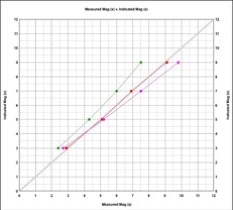
This can vary between good enough and awful depending on the individual scope. You could use MAGCalc or similar software to re-calibrate the zoom ring.
The graph compares actual magnification v. indicated magnification for typical 3-9x40 scopes: a Hawke Vantage (good), a cheap Barska (barely useable) and a ‘no-name’ Chinese clone (no comment).
FFP scopes: The magnification indicated by the zoom ring is irrelevant since the target image is scaled at the same rate as reticle. i.e., the actual magnification is always identical to the calibration magnification.
Muzzle Energy
Muzzle Velocity
The velocity of a projectile (pellet, bullet or arrow) as it emerges from the muzzle.
Measured as Feet per second (Ft/s) or Metres per second (m/s).
The Kinetic Energy of the projectile as it emerges from the muzzle.
See Calculations for the details or here for a downloadable nomograph.
Sight Height
Parallax Error
Precision
Speed of Sound (Mach 1)
A PoI error resulting from inaccurate focusing or failure to view the target through the optical centre of the scope. Note that, if the scope is accurately focused on the target, any offset from the optical centre is irrelevant.
A combination of a metric of dispersion and accuracy (UK) or, in the USA, dispersion only (with no reference to accuracy).
The sight height is the distance between the LoS and the LoD measured at the muzzle,
i.e., where the trajectory and external ballistics begin.
The sight height is fairly important in low-velocity, short zero range applications such as airguns and crossbows and simply measuring the the difference between the objective centre and the bore centre will lead to considerable errors at longer ranges.
The ‘Tin-foil’ method of measuring sight height is usually recommended because it measures the sight height under dynamic conditions (recoiling/spring-powered airguns can move around alarmingly before the pellet exits the muzzle, PCP usually less so) and the method automatically takes account of the angle between bore and line-of-sight.
The Tin-foil method - at all times ensuring that all safety precautions are observed:
- Zero the gun as normal.
- Obtain a small sheet of aluminium foil - about 6” x 6” is fine - and pierce the centre with a small
hole (2 - 3mm) - Set the scope at its minimum focus
- Position the aluminium foil over the front of the objective lens so that the hole is central and
secure the foil in position with an elastic band - Draw a spot or cross on the centre of a sheet of paper and fix the sheet to a safe pellet-catcher.
An old telephone directory or thick retail catalogue will do fine. - Hold the rifle - using your usual holding style - and, moving as close as possible to the target
(without actually touching it) align the scope’s crosshair on the cross/spot on the target.
Depending on the size of the hole in the aluminium foil, the image might be a little blurred - it’ll
certainly be quite dim. If it’s too dim then apply more light to the target. - When the alignment if perfect, fire the shot.
- Measure the distance between the centre of your cross/spot and the centre of the impact hole.
- You might want to repeat steps 6 - 8 a few times (rotating the target after each shot) and take
an average. - This is the sight height to be used in ballistics applications.
The speed of sound (in air) can be viewed (for all practical purposes) to depend exclusively on the air temperature.
This is important in external ballistics since standard Drag Laws (Drag Coefficient v. velocity) are plotted in terms of Mach values thus making them independent of temperature.
Terminal Ballistics
Trajectory
The study of the projectile and its impact after it has hit the target.
The arc of a projectile through the air from muzzle to target.
Point Of Aim (PoA)
The intended impact point on a target.
Point Of Impact (PoI)
The point on the target where the pellet/bullet strikes or, in this context, the vertical
distance between the line of sight and the point of aim.
Spindrift
Wind drift
The tendency for a projectile to drift sideways away from the LoD under still (no wind) conditions. The magnitude of drift is small at airgun ranges but can be significant for full-bore long-distance shooting. A function of overall stability, rifling direction and twist rate, bullet-shaped projectiles fired from a right-hand twist barrel will drift to the right and diabolo airgun pellets tend to drift to the left of the LoD.
Horizontal Drift
The tendency for a projectile to drift laterally at range under the influence of a
disturbing wind force.
Vertical Drift (aka. Aerodynamic Jump)
The tendency for a projectile to drift vertically at range under the influence of a
lateral disturbing wind force.
The sign of Cg depends on whether the projectile’s centre-of-gravity is behind its
centre-of-pressure (negative for a typical bullet) or ahead (positive for a typical diabolo pellet) since diabolo airgun pellets are usually aerodynamically stable by design whereas bullets are not.
If a number of shots are taken at the target under different wind-speed and direction conditions then they will be seen to form a string across the target sloping either up or down. This will depend on the direction of the wind vector (from the right or left), the direction of the rifling (clockwise or anti-clockwise) and the sign of Cg (positive for a diabolo pellet, negative for a bullet).
i.e.,
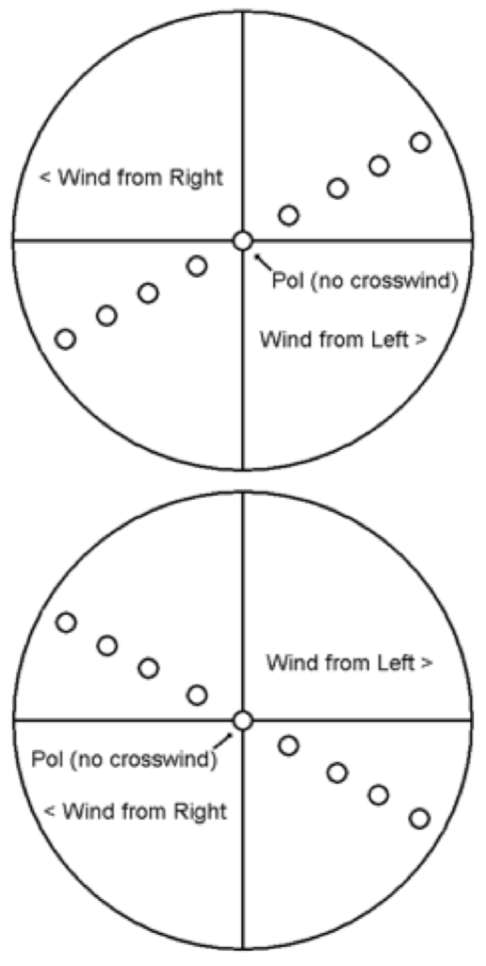
Bullet, clockwise rifling or
diabolo airgun pellet, anti-clockwise rifling.
Bullet, anti-clockwise rifling or
diabolo airgun pellet, clockwise rifling.
Zero(ed) Range
The point at which the pellet/bullet/arrow crosses the LoS.
In most cases there will be two such points; the nearest to the muzzle is
usually called the Primary Zeroed Range whilst the further point is often called the
Secondary Zeroed Range. If there is only one point then this, by definition, corresponds to the point where the Apogee is zero (i.e., the trajectory just touches the LoS).